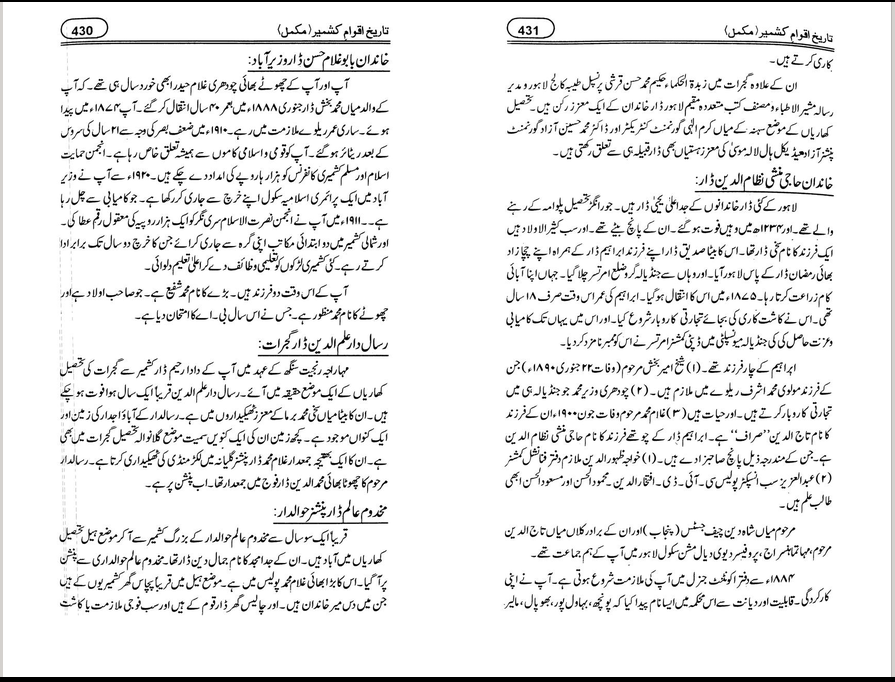
the dar clan
The Dar/Dhar clan is native of Kashmir valley, historically rooted in the
Valley and deeply settled in Fateh Kadal within Shehr‑e‑Khaas, Srinagar, is
recognized as one of the oldest documented hereditary lineages of the region,
descending from Indo‑Aryan Brahman ancestry that transitioned through
Islamization between the 14th and 16th centuries.
The clan is associated with agrarian, administrative, and
landholding roles in pre‑modern Kashmir, serving as village‑level record
keepers, negotiators, intermediaries, land stewards, and custodians of oral
history, inter‑family alliances, and Kashmiri cultural heritage. Their socio‑cultural
and administrative functions included participation in regional governance,
trade, artisan work, clerical service, and community mediation, with documented
mobility extending into Jammu, British Indian Punjab and frontier regions (now part of Pakistan), during the 19th and
20th centuries.
The ancestral household of the Dar/Dhar clan was located
in Fateh Kadal, forming part of the traditional settlement cluster within the
historic Seven Bridges (Sat Kadal) corridor Fateh Kadal, Safa Kadal, Nawa
Kadal, Zaina Kadal, Ali Kadal, Habba Kadal, and Amira Kadal each representing a
genealogical connector reflecting origin, clan role, migration, oral tradition,
documentary evidence, diaspora dispersion, and continuity.
Fateh Kadal served as the core ancestral mohalla,
characterized by narrow interconnected lanes (kochas), mixed Pandit–Muslim
settlement, proximity to Zaina Kadal and Safa Kadal, and traditional wooden‑brick
residential structures forming clustered family compounds typical of Dar/Dhar
households. The household itself was situated inside the inner residential
lanes east of Fateh Kadal bridge, bounded by a residential lane leading toward
Zaina Kadal to the north, an inner mohalla courtyard used by multiple Dar/Dhar
families to the south, a narrow passage connecting to Safa Kadal trade street
to the east, and the approach road descending from Fateh Kadal bridge to the
west.
Its architectural layout followed the classical Shehr‑e‑Khaas
pattern, consisting of a semi‑open front courtyard (dalan), a two‑storey wooden‑brick
main residential block with carved Kashmiri window frames, an inner family
courtyard used for gatherings and household activities, and a rear passage
(kochi) connecting to markets and religious sites.
This household was historically occupied by Mian Noor Din
Dar, the last generation fully resident in Srinagar before migration, who held
hereditary Dar/Dhar lineage and performed administrative and clerical work,
possessed Persian literacy, engaged in artisan and trade activity, and served
as a community mediator.
In 1938, Noor Din Dar migrated from Fateh Kadal along
established regional routes through Banihal, Jammu, and Sialkot, eventually
settling first in Village Sehna, Tehsil Kharian, District Gujrat, and later in Mohallah Chibban, Lyallpur (now Faisalabad), forming a migration chain that
continues to the present generation. This migration reflects broader pre‑Partition
Kashmiri mobility driven by economic opportunity, administrative relocation,
and socio‑political pressures.
The Seven Bridges Lineage Overlay integrates these
ancestral, migratory, and socio‑historical layers into a unified genealogical
map, documenting origin in Kashmir, clan roles, migration routes, oral
tradition, archival evidence, diaspora settlement including North American
dispersion such as Toronto and present‑day lineage continuity through
institutions such as KLIRF, KOBA, and MKET. The Dar Clan Household Location
Certificate verifies Fateh Kadal as the ancestral household site, supported by
genealogical testimony, clan elder verification, oral historical accounts,
archival records, and diaspora documentation.
The household map description situates the residence
within a traditional Kashmiri settlement cluster featuring orchard belts,
agricultural fields, irrigation channels, water sources, cultural landmarks,
and clan‑specific sites, while the migration‑era map description provides a
spatial narrative of the 1938 relocation, marking the transition from ancestral
residence to new settlements in Punjab.
Collectively, these documents affirm the bearer’s direct
descent from the Dar/Dhar lineage, preserve Kashmiri clan heritage, and provide
authoritative genealogical, cultural, and historical evidence suitable for
archival, institutional, and SSC‑1 hereditary lineage documentation.